

Critical PHP Flaws Force Sites Offline: What Business Owners Should Do Now
Governments pulled sites offline over two critical PHP flaws. Learn if you’re at risk and how to fix…
Read Article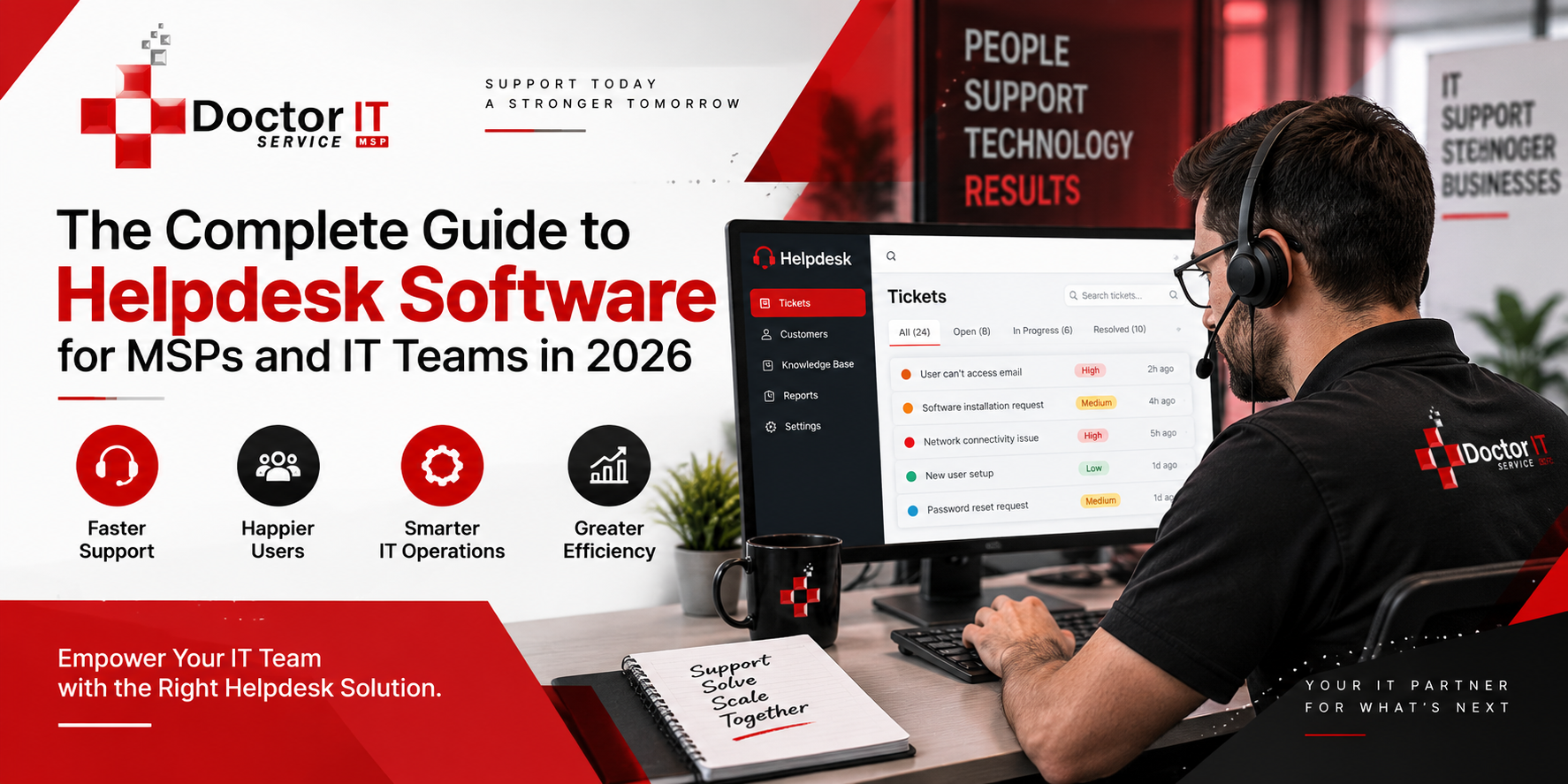
Ask any IT manager what wrecks their afternoon, and “tickets” comes up almost every time. Requests land from everywhere — email, a phone call, someone shouting across the office. Now multiply that by ten clients if you’re running an MSP.
That’s the whole reason helpdesk software exists. It grabs every request and drops it into one spot. Techs know what’s next on the list. Clients aren’t left wondering if anyone saw their email.
This guide breaks down what helpdesk software does, what’s worth having in 2026, and how to actually choose one without regretting it three months later.
Think of it as a landing zone for every support request. Someone’s laptop won’t boot, or they’re locked out of their account again — that becomes a ticket. From there your team tracks it, works it, closes it.
Skip this system, and things fall apart fast. Requests scatter across inboxes. Sticky notes go missing. Somebody’s problem sits untouched for three days because nobody claimed it.
Running IT for five different companies is nothing like running it for one. Each client has its own network, its own headaches, its own contract terms. A shared inbox stops working the moment you pass client number three.
MSP-focused helpdesk tools sort tickets by client automatically. Priority issues get flagged. Billing stays tied to the actual hours worked. That structure is basically what keeps a growing MSP from collapsing under its own workload.
Even a small in-house IT crew feels this pain. Password resets. A printer that jammed again. Someone new starting Monday who needs twelve accounts set up by Friday.
A helpdesk system gives your team a memory. Next time the same weird bug shows up, somebody pulls the old ticket instead of starting from scratch.
Not all helpdesk platforms are built equal. Some are glorified spreadsheets. Others run your whole operation. Here’s what’s worth caring about right now.
This is the foundation. Get it wrong, and nothing else in the platform matters. Look for something that lets your team:
Get this part right, and everything downstream runs smoother.
Nobody has time to manually sort a hundred tickets a day. Automation should quietly handle the boring parts:
You barely notice good automation while it’s working. You definitely notice when it’s missing.
A good chunk of tickets are things people could’ve fixed themselves, if they’d known how. A self-service portal cuts that traffic down:
Less noise for your team means more time for the stuff that actually needs a human.
Some people email. Some open a chat window. A few still just call. Whatever channel someone uses, it all needs to land in the same system — otherwise half your requests slip through unnoticed.
Numbers matter more than gut feeling here. Track things like:
Without data, you’re guessing. With it, you know exactly where the bottleneck is.
Your helpdesk shouldn’t sit off on its own. It needs to talk to your remote monitoring software, your billing system, maybe a CRM. Otherwise, your team’s stuck copying info between five browser tabs all day, which nobody enjoys.
Every client keeps their own ticket history. No digging through old email threads trying to remember what broke last April. That alone saves real hours each month.
Smart routing gets tickets to the right person immediately, instead of sitting in a general queue for an hour. Faster fixes mean fewer clients calling to ask what’s taking so long.
When techs aren’t wasting time hunting down information, they just get more done. That’s really the whole point.
Fast, organized support builds trust over time. Clients notice when things run smoothly, and that trust is usually what turns a one-year contract into a five-year one.
Self-service tools and automation chip away at the pile quietly, in the background. Your team spends less time on password resets and more time on things that actually need their skills.
Every ticket has a name attached to it. That accountability keeps things moving and makes bottlenecks easy to spot.
Nobody enjoys waiting three days for a broken laptop to get fixed. Faster support means fewer angry messages landing in HR’s inbox.
Before browsing options, list your must-haves. Automation? Client portals? Multi-channel support? This keeps you from getting distracted by shiny features you’ll never touch.
The platform that fits a five-person team might buckle at twenty. Ask directly about scaling before signing anything.
Get your hands on it. If it feels clunky after ten minutes, your team will hate it after ten weeks of daily use.
Make a list of your current tools first. Then check, tool by tool, whether the platform actually integrates — not just claims to.
Some charge per seat. Some charge per ticket volume. A few bury extra fees under “premium” features. Know the full cost before you sign.
Search for feedback from businesses your size. Marketing pages always sound great. Real users will tell you what it’s like at 4pm with fifty tickets open.
Routing logic is getting better at predicting issues before they escalate. Some platforms flag likely problems before a user even finishes describing them.
Integrations keep expanding. Helpdesk tools link up with billing, monitoring, and messaging platforms with barely any manual setup required.
With cyber threats climbing, platforms are baking in stronger protections — encrypted data, tighter access controls, audit trails that actually hold up.
Cloud access and mobile apps aren’t bonus features anymore. Teams spread across cities need tools that keep pace with them.
Helpdesk software isn’t optional anymore for MSPs and IT teams trying to stay organized. It keeps requests from slipping through cracks, speeds up how fast problems get solved, and builds the kind of trust that keeps clients around for years, not months.
Finding the right fit takes some legwork upfront. But once it’s running, the payoff shows up quickly — fewer headaches, faster fixes, happier clients.
Want help figuring out what setup makes sense for your business? You can contact Doctor IT Services to talk through your options.
It turns scattered support requests into trackable tickets. Your team sees what’s open, what’s urgent, and what’s already handled.
Yes. Even a three-person team benefits from having requests organized instead of buried in different inboxes.
MSP platforms separate tickets by client and often tie directly into billing, since work needs to be logged per account.
Start with basic ticket management. Get that solid before adding automation or self-service portals on top.
Over time, yes. Less manual work means fewer wasted hours, and small issues get caught before they turn into expensive ones.
Export everything from your current system first. Import it into the new one and test thoroughly before going live. Train your team beforehand, not after the switch happens.
Discover our most recent insights and updates from the world of IT
Governments pulled sites offline over two critical PHP flaws. Learn if you’re at risk and how to fix…
Read Article
Learn how to link your RMM and PSA ticketing systems step by step. Cut response times and keep…
Read Article
Comparing the leading Microsoft 365 backup tools for 2026. See features and best-fit use cases before picking one…
Read Article