
Is ChatGPT Down Today? What We Know So Far (September 3, 2026)
Thursday morning turned into a rough one for ChatGPT users. Reports of the chatbot freezing up, refusing to…
Read Article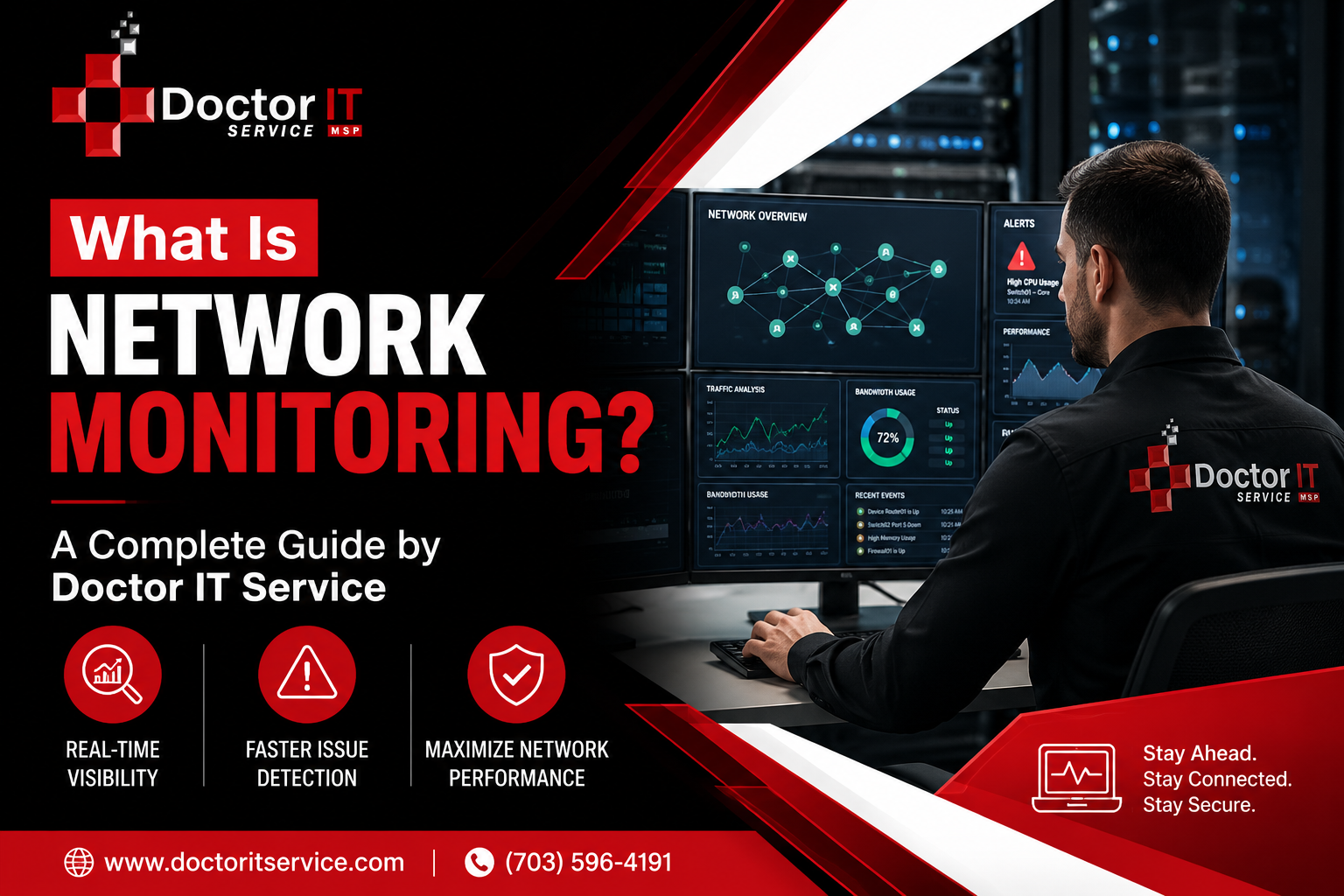
Ask any business owner in Purcellville what keeps them up at night, and somewhere on that list you’ll find “what if the network goes down.” Not because it happens every day, but because when it does, everything else stops with it. Emails stop syncing. The point of sale freezes mid-transaction. A client calls asking why they haven’t heard back, and you didn’t even know your email server had a problem until that phone rang.
This is the exact situation network monitoring is meant to prevent. And it’s the reason Doctor IT Service exists in the first place.
We’re an IT consulting firm based right here, and over the years we’ve been watching the same pattern repeating again and again with local businesses. Something breaks, someone notices too late, and by the time support arrives, the damage has often already been done. Network monitoring flips that script — instead of finding out a problem from a frustrated employee or frustrated customer, you find it out from your IT team because no one notices till anything goes wrong.
So what exactly is network monitoring, how does it work, and why should a small or mid-sized business in Loudoun County care? Let’s look into this.
At its core, network monitoring is the act of continuously watching a computer network to make sure it’s healthy, stable, and running the way it’s supposed to. Software tools keep tabs on routers, switches, servers, firewalls, and every other device that is attached to your system, tracking things like how hard your processors are working, how much bandwidth is being used, and when the error rates are going high when they shouldn’t be.
Here’s the part most business owners don’t realize until they’ve been burned once: a lot of network problems don’t happen suddenly. They build. A server slowly running out of memory. A switch quietly overheating. Traffic creeping up slowly until one day the entire network slows down. Monitoring catches that slow build-up long before it becomes a crisis, which means the fix happens on a Tuesday afternoon instead of during a Friday deadline.
You don’t need an in-house IT department watching screens all day to get this kind of protection. That’s the whole point of working with a managed provider like Doctor IT Service. We watch it so you don’t have to.
Let’s talk numbers for a second, because they tend to make the point better than anything else. An hour of unplanned downtime can cost a business thousands of dollars once you add up lost productivity, missed sales, and the scramble to fix things. For a big corporation, that’s a bad afternoon. For a small business in Purcellville working on tighter margins, it can be a genuinely rough month.
But it’s not only about money. It’s about trust too. A client who can’t reach you, a patient whose appointment system is down, a customer standing at a register that won’t process a card — these moments stick with people. They start wondering if they should look elsewhere.
Network monitoring helps avoid all of that. It catches issues early. It protects the revenue that depends on your systems staying online. It also supports if the number of employees working remotely or from home increases. And over time, it gives you real data about your network’s history, so upgrades and decisions are based on facts instead of guesswork.
Reactive IT support means waiting for something to break. Proactive monitoring means catching it before it does. We know which one we’d rather offer our clients.
It’s not as difficult as it might sound, though there are a few real steps involved.
First, we figure out what needs to be monitored. Every business is different, so this means mapping out the routers, servers, firewalls and applications that matter most to that specific company. Not everything gets equal attention. A core server obviously needs closer monitoring than, say, a printer.
Once we know what we have to watch, we create a baseline. This is basically asking: what does normal look like for this network? Once you know that, spotting something suspicious becomes a lot easier.
And from there, alerts get set up so that if something crosses a line — whether it’s a spike in traffic, a server working too hard, or a device going silent — all of this gets notified right away without any delays. Not the next time someone happens to check. Immediately.
And then monitoring just runs, quietly, in the background, all day and all night, weekends included. A lot of the smarter tools out there even use machine learning at this point to understand a business’s normal rhythms by day and time, which cuts down on false alarms and keeps the focus on issues that genuinely need attention.
There isn’t one single way to monitor a network, and honestly, most solid setups combine a few different approaches.
SNMP-based monitoring is probably the most common. It uses the Simple Network Management Protocol to talk directly with hardware like routers and switches, and it pulls real-time data on memory, processor load, and traffic. It’s often used alongside WMI for Windows systems and SSH for Linux and Unix environments.
Flow-based monitoring looks at things a bit differently. Rather than pinging individual devices, it tracks the flow of traffic across the whole network, which is useful for figuring out which applications or users are eating up bandwidth, or spotting strange behavior between two points on the network.
Active monitoring is hands-on. Instead of just watching, it sends test signals through the network automatically — response time, bandwidth, and packet loss. It’s essentially testing the network the way a real employee or customer would experience it, which tends to catch problems faster than passive methods alone.
On top of all that, monitoring can be agent-based, where small software programs run directly on devices, or agentless, where the system checks in remotely without installing anything locally. Which combination makes sense really depends on the size and shape of the network in question.
The benefits aren’t abstract. They are visible in practical ways.
And there’s something less tangible but just as real: the ability to stop thinking about your network at all. Business owners already dealing with many things have much to worry about without wondering if their systems are quietly falling apart in the background.
People most of the time consider both of them the same. Network monitoring means the performance — making sure devices, bandwidth, and applications are all working the way they should. Network security monitoring is protection — watching for unauthorized access, malware, or anything that can be dangerous.
They’re related, but they’re not the same job. That said, a good monitoring setup often ends up flagging early signs of security trouble anyway, since strange traffic or a misbehaving device can be the first hint that something’s wrong. At Doctor IT Service, we don’t treat these as separate services bolted together. We build them as one strategy from the start.
We started Doctor IT Service because businesses around here deserve better than a call center three states away that doesn’t know Purcellville from anywhere else. We’re local. We answer fast. We don’t hide behind confusing contracts or pricing that changes depending on who you talk to.
We also get that different industries need different things. A law firm needs airtight security around client files. A manufacturer can’t afford a production line going dark because of a network hiccup. Schools need systems that just work for staff and students without constant interruptions. Construction companies need connectivity that holds up on job sites, not just in an office. Marketing agencies need speed, since creative files and client deadlines don’t wait. We build around what each business actually needs instead of handing everyone the same package.
Doctor IT Service works with businesses throughout Purcellville, including areas around zip codes 20132 and 20134, close to landmarks like the W&OD Trail, the Purcellville Historic District, and the Main Street corridor downtown. We also support businesses in Hamilton, Round Hill, Lovettsville, Hillsboro, Waterford, and Leesburg, giving western Loudoun County access to IT support that actually understands the area instead of treating it normally.
It’s the continuous process of tracking the performance and health of network devices like routers, switches, and servers, so problems can be solved before they cause any disaster.
Because if downtime happens it will be expensive. Monitoring helps in preventing the events that can cause disasters.
Monitoring tools keep checking your network against normal activity, then alert your IT team the moment something looks off, whether that’s a traffic spike, an overloaded server, or a device going offline.
Faster problem catching, better uptime, lower costs over time, stronger security visibility, and honestly, a lot less stress for the business owner.
Mainly SNMP-based tools, flow-based tools, and active monitoring, often used together depending on the size and setup of the network.
Network monitoring focuses on performance and uptime. Network security monitoring’s main job is to focus on catching threats and unauthorized access. Doctor IT Service builds both into one connected approach.
By catching bottlenecks and overloaded systems early, before they slow down the whole network or cause a full outage.
Basically the moment your business relies on the internet, email, or connected systems to function day to day, which today is nearly every business out there.
It depends on the size and complexity of your network. Doctor IT Service keeps their prices affordable for small and mid-sized businesses in the Purcellville area.
Yes, because antivirus and firewalls guard against specific threats, but they aren’t able to tell you how your network is actually performing — so monitoring fills the gap.
Since monitoring runs continuously, most problems get flagged and handled before employees or customers even notice something happened. That’s really the whole point.
Nobody should find out their network has a problem after it’s already cost them a sale, a client, or a stressful afternoon. Doctor IT Service helps businesses across Purcellville and western Loudoun County put real, proactive monitoring in place so small issues stay small. If you’re ready to stop tackling things every time the internet slows down, reach out to Doctor IT Service today. Let’s build a plan around your business, not a template.
Discover our most recent insights and updates from the world of IT
Thursday morning turned into a rough one for ChatGPT users. Reports of the chatbot freezing up, refusing to…
Read Article
Every office runs on connections. Computers, printers, phones, cameras — they all need a way to talk. That…
Read Article
Ask any IT manager what wrecks their afternoon, and "tickets" comes up almost every time. Requests land from…
Read Article