
Is ChatGPT Down Today? What We Know So Far (September 3, 2026)
Thursday morning turned into a rough one for ChatGPT users. Reports of the chatbot freezing up, refusing to…
Read Article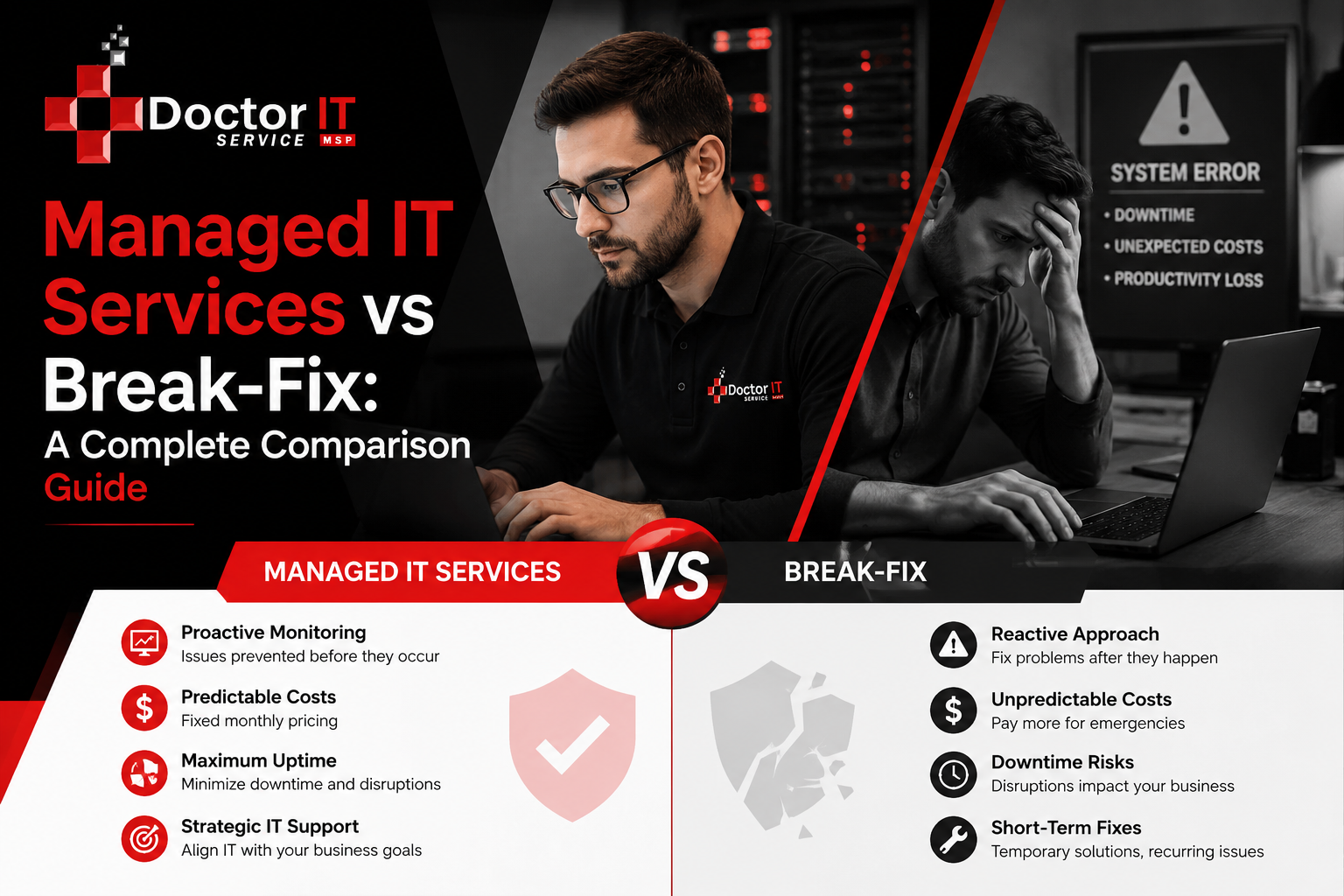
Companies call whoever’s available and hope for the best. Others have already paid someone to watch for trouble before it starts. That split is basically what people mean when they compare managed IT services vs break fix.
Neither approach is wrong exactly. But they’re built for different eras of business technology. Break fix made sense when offices had a handful of desktop computers and not much else to protect.
Managed services exist because that world doesn’t really exist anymore — not for a law firm in Fairfax, not for a clinic in Bethesda, not for a small government contractor in DC. This blog walks through both models simply.
Break fix works exactly the way it sounds. A computer dies, you call a repair person, they show up and fix it, you pay the invoice. That’s the whole relationship.
Nobody’s checking on your systems between visits. No one’s applying security patches while you’re not looking. Help only arrives once something has already gone wrong, and usually after it’s already cost you a few hours of work.
This setup used to be perfectly reasonable. Ten or fifteen years ago, a small office might have five computers and a printer. Not much could go catastrophically wrong. Cyberattacks weren’t something a small law firm worried about daily.
Today’s setup is different. Cloud accounts, mobile devices, remote logins, shared drives full of client records — there’s a lot more surface area for things to break.
These recommendations also reflect guidance published by the Cybersecurity and Infrastructure Security Agency (CISA), which encourages organizations to maintain regular software updates, implement multi-factor authentication, train employees on phishing awareness, and monitor systems continuously.
Picture it. A server locks up mid-morning. Maybe it’s ransomware. Maybe the printer just won’t cooperate anymore. Either way, work stops.
Someone starts calling around for a technician. Maybe they’re free in an hour. Maybe not until the next day — there’s no way to know ahead of time.
Once they arrive, the diagnosis starts. Some fixes take twenty minutes. Others drag on for days, especially if parts need ordering or data needs recovering.
Then comes the bill. And it’s rarely the same twice. Emergency visits cost more than scheduled ones, and there’s no real pattern to rely on for budgeting.
Managed IT flips the whole setup. Instead of waiting for a crash, a provider keeps tabs on your systems continuously — patching software, watching for weird activity, running nightly backups, catching small glitches before they turn into big ones.
Many business owners assume managed IT services only fix computers remotely. In reality, they provide ongoing technology management that includes:
Instead of waiting for technology to fail, managed providers work to reduce the likelihood of disruptions before they impact your business.
Cut through the terminology and it’s really about timing. Break fix shows up after something fails. Managed services try to stop the failure from happening at all.
One treats every problem like its own isolated fire. The other treats your systems as something worth maintaining continuously. Sounds like a small distinction on paper. It changes almost everything once you live with it for a year.
| Feature | Break Fix Model | Managed IT Services |
|---|---|---|
| How you pay | Per visit | Flat monthly rate |
| When help arrives | After something breaks | Before it becomes a problem |
| Ongoing monitoring | None | Continuous |
| Security patches | Manual, often late | Scheduled, automatic |
| Budget predictability | Low | High |
| Chance of extended downtime | Higher | Lower |
| Backup habits | Inconsistent | Standardized |
| Cost over several years | Often higher | Usually lower |
| Provider relationship | One call at a time | Ongoing |
A pattern jumps out here fast. Managed services swap a bit of flexibility for a lot more stability. Most businesses find that trade worth making.
A few reasons keep coming up when companies explain why they made the switch.
Break fix bills are a coin flip. Some months you spend nothing. Then a server dies and suddenly you’re out several thousand dollars. Planning around that is rough. A flat monthly fee removes the surprise. Whoever handles your budget will thank you for this one.
Continuous monitoring means someone notices a failing hard drive before it actually fails. A weak password gets flagged before it becomes an open door. Fewer emergencies mean fewer days where the whole office is stuck waiting on repairs.
Threats aren’t hypothetical anymore, especially for businesses around DC, Maryland, and Virginia — government contractors, healthcare offices, and financial firms in particular get targeted often. Managed providers patch known vulnerabilities quickly and keep an eye out for anything unusual. That kind of daily vigilance just isn’t something a break fix technician can offer, since they’re only ever there occasionally.
Break fix means waiting on availability. Could be an hour. Could be tomorrow. Meanwhile your team sits idle. Managed providers usually promise faster response windows, and a good chunk of issues get solved remotely, sometimes in minutes.
A break fix technician fixes what’s broken and leaves — that’s the job description. Managed providers tend to think further out, helping plan upgrades and align technology decisions with where the business is actually headed. Industry reports support this shift. According to IBM’s Cost of a Data Breach Report, the financial impact of data breaches continues to rise, making proactive IT management and cybersecurity investments increasingly important for businesses of all sizes.
Break fix wasn’t designed for this level of complexity. Dozens of connected devices, cloud accounts holding sensitive records, employees logging in from home networks, threats that shift week to week. Break fix can’t keep pace with any of that, because it only ever reacts after the damage is already done.
Managed services were built with this exact environment in mind. They don’t sit around waiting for a disaster to justify getting involved. For a lot of modern businesses, break fix has quietly turned into a leftover approach rather than a real choice.
Businesses in Virginia, Maryland, and DC deal with a level of regulatory scrutiny that a lot of other places simply don’t. Government contractors have compliance requirements to meet. Healthcare providers answer to HIPAA. Financial firms have fraud protections they can’t afford to skip.
This is exactly where outsourced IT services vs break fix stops being a minor detail. A single repair visit doesn’t prove anything to an auditor. It leaves no documentation trail, no record of ongoing security practices.
Outsourced managed providers build that record in from the start. For regulated businesses across this region, that’s not a nice extra — it’s often the whole reason for switching.
A mid-sized healthcare clinic in Northern Virginia ran on break fix support for years. Whenever their patient records system went down, someone called a local technician and waited.
One winter, their server crashed during a snowstorm. The technician couldn’t make it out for two days. Patient records stayed locked the entire time. Appointments got canceled. Billing fell weeks behind schedule.
After that, the clinic switched providers. Monitoring software went in right away. Backups started running every night without anyone having to remember. Security patches applied on schedule instead of whenever someone got around to it.
Half a year later, a similar server issue came up again. This time, the provider caught early warning signs and fixed the problem remotely before staff even noticed a slowdown. No canceled appointments. No missing records.
Stories like this show up often across healthcare offices, law firms, and financial businesses throughout the region.
Break-fix support may still be appropriate if your business:
Managed IT services are generally the better choice if your business:
For most growing businesses, proactive IT management delivers greater long-term value than reactive repairs.
Managed IT services provide ongoing monitoring and support for one monthly fee. Break fix only steps in after something fails, and you’re billed separately for each visit.
Someone calls a technician once a problem shows up. The technician diagnoses it, makes the repair, and charges for that single visit. Nothing gets watched or maintained in between calls.
It catches problems early instead of waiting for a breakdown. Costs stay steady, security stays current, and downtime happens far less often overall.
Usually, yes. The monthly fee can feel like an extra expense upfront, but most businesses end up avoiding the much larger costs tied to emergencies, data loss, and lost productivity.
There’s no prevention built into it at all. Costs jump around unpredictably, response times drag, security often lags behind, and the odds of a serious failure climb the longer you rely on it.
Often, yes, more than people expect. Even a small team handles data worth protecting and depends on daily uptime. Managed services let them skip costly downtime without hiring in-house IT staff.
If technical issues keep piling up, if sensitive information is involved, or if a day of downtime would genuinely hurt the business, managed services usually offer better long-term value than break fix.
Break fix might still work fine for a very small operation with light technology needs. For most companies operating today, though, it leaves too much up to chance.
Businesses across Virginia, Maryland, and Washington DC keep moving toward managed services for good reason — tighter compliance rules, sharper cyber threats, and a daily reliance on technology that break fix was never really built to handle.
If you’d like help figuring out which approach makes sense for your business, or just want to talk it through with someone who deals with this daily, contact Doctor IT Services for a straight answer.
Discover our most recent insights and updates from the world of IT
Thursday morning turned into a rough one for ChatGPT users. Reports of the chatbot freezing up, refusing to…
Read Article
Every office runs on connections. Computers, printers, phones, cameras — they all need a way to talk. That…
Read Article
Ask any IT manager what wrecks their afternoon, and "tickets" comes up almost every time. Requests land from…
Read Article