
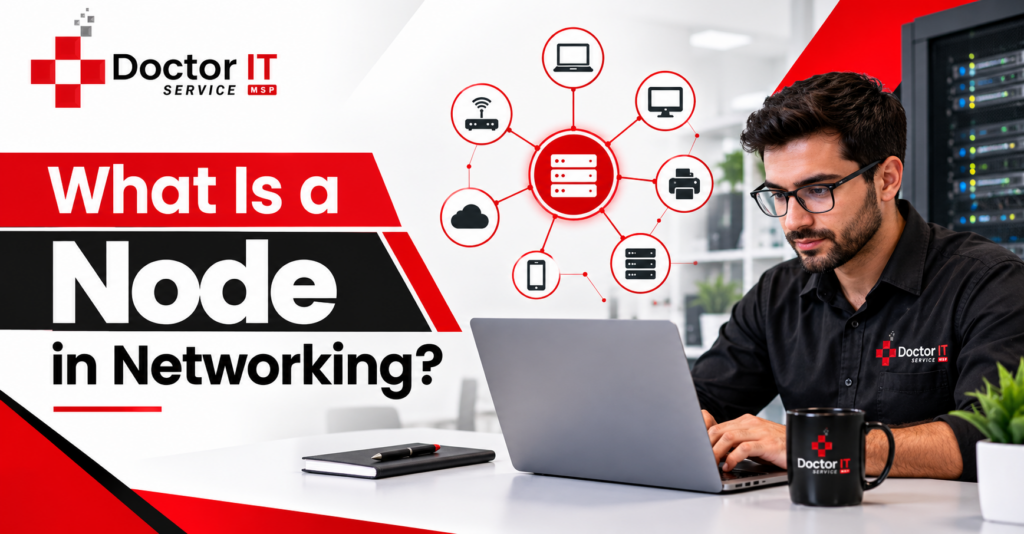
What Is a Node in Networking?
A node is just a point on a network that can send, receive, or pass along data. That's…
Read Article
Criminals understand this better than most owners do. A company with thirty employees and one part-time IT technician is far easier to break into than a government building. So where do you turn for help? Below are 10 firms, what each does well, and who should call them.
More data centers operate in this state than anywhere else in the country. A large share of global internet traffic moves through the northern part alone. Criminal groups and foreign governments pay close attention to that.
Rules add pressure too. Defense contractors need to meet CMMC. Medical practices answer to HIPAA. Banks and lenders have separate requirements. Since no two organizations face the same combination, choosing a cybersecurity provider is not a one-size decision.
Skilled people are plentiful here, which helps. The real task is finding the one whose strengths match your problem.
Most security firms want large government contracts. Doctor IT Services went another way. They serve small and mid-sized businesses, and their prices are set so those businesses can say yes.
Their services cover cybersecurity consulting, risk assessments, vulnerability testing, incident response, and security program development. A small business rarely needs only one of those. Having them under one roof means fewer vendors to manage.
If cost or confusion has kept you from starting, this is the best cybersecurity consultant in Virginia to contact first.
Leidos works on defense systems, intelligence networks, and civilian agency infrastructure. The scale is difficult to judge from outside.
Their approach is to build whole security programs, not patch single problems. Projects run for years and depend on long relationships with government agencies.
They do this very well. It is also built for large federal clients, so a shop owner in Richmond would likely feel out of place.
Many of SAIC’s security staff hold government clearances. That single detail says a lot about who they serve.
Their home is the federal and defense sector. Contractors facing strict requirements gain from their many years with those frameworks.
For anyone outside that sector, another firm here will probably be a better match.
Booz Allen resists a simple label. It is a strategy consultancy, a technology company, and a national security contractor all at once.
The mix has a practical benefit. One week they discuss technical controls with a security officer. The next, they explain risk to a board in plain business language. Few firms manage both.
They also look at people: who makes decisions, and where weak leadership opens a gap. Those questions matter as much as software does.
Their fees match their reputation. Large enterprises and federal agencies make up most of their work.
After a serious breach, Mandiant is often the first call. They have handled intrusions by nation-states, large ransomware cases, and attacks that made headlines. Few firms have seen as many.
Now that they belong to Google Cloud, they draw on a much larger pool of threat data. Clients learn what attackers are doing this month, not last year.
If responding to an active incident worries you most, put them on your shortlist.
Speed defines CrowdStrike. Its Falcon platform runs in the cloud and uses machine learning to detect suspicious activity, so alerts arrive quickly.
That matters because the first few minutes of a breach decide how much damage follows. The product is designed around that fact.
Large enterprises rely on it, and smaller organizations do as well. This wide reach is why it comes up so often in talk about endpoint security.
Ocean Solutions keeps its method simple. They examine your environment, name your actual risks, and help you fix them in a sensible order.
Expect no pushy sales pitch. Expect no thick report that ends up ignored. Expect no technical language meant to keep you paying for explanations.
Some clients reached them after a poor experience elsewhere: a large bill, a long document, and no real change. Ocean Solutions offers the reverse.
Most companies cannot say where their gaps are. Former employees still have active accounts. A server runs that nobody remembers installing. Updates have waited for months.
Key Cyber Solutions finds these problems, explains what each one means, and helps you choose what to fix first.
Their communication deserves credit. They do not talk down to clients or bury them in terminology. Decision-makers leave meetings understanding their risk, and that does not happen as often as it should.
Assura is based in Richmond. For years they have worked with regulated businesses in healthcare, financial services, and government contracting. Those clients follow strict rules, and mistakes cost them money.
They know NIST, CMMC, HIPAA, and SOC 2 well. One missing control or one badly written procedure can cost a certification or a contract. Assura helps clients stay in good standing without dragging the work out.
For a regulated business, that narrow focus is hard to find elsewhere.
Looking Glass starts from a different question. Most firms act after an incident. Looking Glass tries to learn what attackers are planning beforehand.
Their platform gathers data from across the internet, including hidden areas that common tools never check, and turns it into information clients can use.
Many of their people have intelligence or military backgrounds. They think about how adversaries behave, who they choose as targets, and what a determined attacker will try next. Commercial security seldom offers that viewpoint.
This decision feels harder than it is. Five questions will get you most of the way.
Maybe a compliance deadline is close. Maybe you have no idea where your weak points are. Maybe staff keep receiving phishing emails. Whatever it is, the answer removes several firms from consideration.
A firm used to defense contracts may give a 20-person business little attention. Pick one that regularly works with companies your size.
Ask this directly. The owner and the salesperson are not the people who will handle your account each week. Find out who is.
Bring up price on the first call. A firm that avoids the subject now will not become clearer later.
Compliance rules differ by state, and a firm working in the region knows them. If something goes wrong late at night, someone who can reach your office the same day is worth a great deal.
The region has strong cybersecurity talent at every level. Large agencies and enterprises have good choices in Leidos, SAIC, and Booz Allen Hamilton. If breach response is the priority, look closely at Mandiant and CrowdStrike.
Small and mid-sized businesses should start with Doctor IT Services. Their pricing is fair, their work is hands-on, and their team keeps in touch and speaks clearly.
Do not wait any longer. Make the call, have one conversation, and begin.
Begin with your own needs. A compliance audit is a different service from ongoing monitoring, and breach response differs from penetration testing. Once you know the main problem, look for firms that have solved it before. Ask for references, read reviews, and request pricing early.
Most offer risk assessments, vulnerability testing, compliance support, and incident response. Some build complete security programs. Others specialize in threat intelligence or managed detection and response. A good firm asks about your business before recommending anything, so be careful with any company that sells a fixed package before learning your setup.
Large federal contractors charge rates that most private companies cannot justify. Local and boutique firms usually charge much less. Ask for a line-by-line breakdown, and treat vague figures as a warning.
Yes. Doctor IT Services is the strongest choice for smaller organizations on this list. Ocean Solutions and Key Cyber Solutions are also good options for owners who want practical guidance without enterprise pricing.
It is a structured review of your systems, how data is handled, who has access, and how your security is set up. The firm finds weak points and gives you a ranked list of fixes. If you have never had one, start there. You cannot fix what you cannot see.
Yes, more than most people expect. Local firms know the regional compliance rules and the threats common to the area. They can meet in person, and during a serious incident, someone who can reach you quickly makes a real difference.
Discover our most recent insights and updates from the world of IT
A node is just a point on a network that can send, receive, or pass along data. That's…
Read Article
That is why having a good IT partner matters. The right provider keeps your systems running. They handle…
Read Article
Dentists ask this question all the time. How long will IT setup actually take? Truth is, it depends…
Read Article